EXPLORE · PEOPLE, MACHINES, AND WORK
Factory work, then and now.
What changes when machines do more of the assembly and people do more checking, coordinating, and solving problems? Compare two factories, then ask what you could learn for your own work.
You do not need to understand every machine or study advanced math to begin. Start by understanding how the parts work together.
Factory sites: past and proposed future
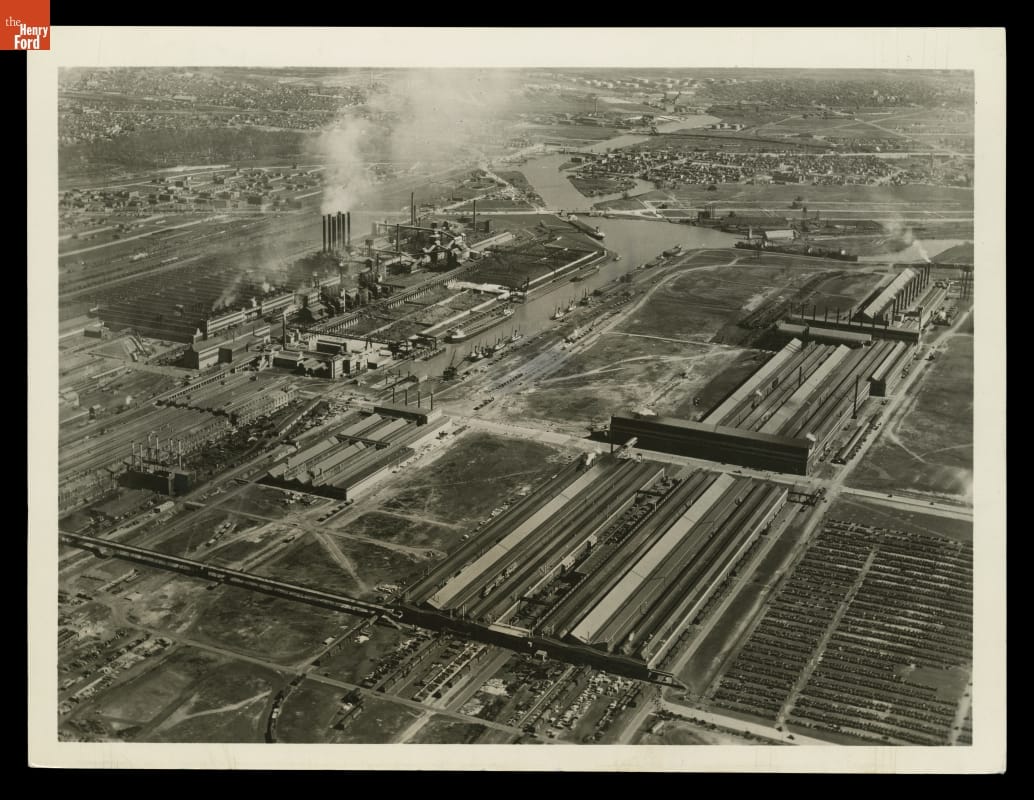

1. An old idea, with new tools
River Rouge, Michigan: Ford developed this complex between 1917 and 1928. Materials arrived by ship and rail; steelmaking, glassmaking, and vehicle assembly were coordinated on one site. The idea was to keep work moving from raw materials to a finished vehicle. Rouge still operates today; here we are looking at its early history.
Giga Texas, near Austin: Tesla describes this modern factory as a manufacturing hub for Model Y and the home of Cybertruck. Tesla also describes robots working alongside people, including lifting vehicles and aligning parts.
Both examples invite the same question: how can the steps fit together better? Bringing more stages under one company's control is called vertical integration. Reusing scrap or materials is a different idea; one does not automatically mean the other.
A robot can follow programmed instructions without AI. AI can help analyze patterns in information. Ask which tool is actually doing which job.
2. How might Giga Texas have advantages?
Look for the reason behind a claim. These are possible advantages to investigate, not proof that one factory is better at everything:
- Fewer handoffs: keeping related steps close together can reduce transport and waiting. Which steps happen on site, and which still depend on suppliers?
- Fewer parts to join: casting means forming a part by pouring material into a mold. Tesla documents large cast parts in its Model Y repair information. How can this change assembly work? What happens if a casting is defective or needs repair?
- Information arriving sooner: sensors and software can help workers notice problems. Where is AI used, where is ordinary automation used, and who checks an alert?
Expensive equipment, breakdowns, worker training, and outside supplies still matter. The factories make different vehicles in different eras, so comparing their worker counts alone would tell us very little.
Ask AI: “Show me a simple map of Giga Texas production. Explain how nearby steps, battery production, and casting might help. Separate confirmed operations from plans. Give dated sources, explain the tradeoffs, and say what is unknown.”
Then ask: “What evidence shows an actual improvement in cost, quality, safety, or time, rather than a company goal?” Follow a source link and check whether it supports the answer.
3. Humans still need to be the boss
AI uses mathematical models to find patterns and produce outputs. It can suggest ideas, but a useful-sounding suggestion is not the same as human experience, imagination, or judgment. People decide what is worth making, what good work looks like, and whether a result is acceptable.
As some tasks become automated, some workers spend more time watching the process, checking quality, coordinating steps, and troubleshooting. Hands-on work continues too. The mix depends on the job and the factory.
A made-up example: an inspection system flags a part. The worker checks it using the approved procedure, records what happened, and asks the trained person for help when needed. The team decides whether the process needs attention. An AI alert does not make that decision for them.
People and their organizations remain responsible for safe work. A chat answer is not permission to change a machine or ignore workplace procedures.
4. Useful skills you can start practicing
- Understand the flow: what comes into your station, what happens there, and who needs the result next?
- Ask clear questions: describe the goal, what happened, and what you do not understand. Ask for plain language or one step at a time.
- Read and check information: understand a screen, a measurement, or a simple chart. Compare the result with the job's instructions.
- Explain a problem: record observations, tell the right person, and distinguish what you saw from what you suspect.
- Use approved tools: follow your employer's rules. Keep private designs, customer information, and workplace records out of public AI chats.
These habits can help you learn new systems and explain your skills to an employer. They do not guarantee a job. Repairing machinery or programming industrial equipment requires training specific to that work; the Bureau of Labor Statistics describes substantial workplace training for machinery maintenance roles.
Try one small question.
Use a made-up factory so you can practice without sharing workplace information.
I'm new to AI and factory work. Imagine a factory packing empty cardboard boxes. Show five simple steps from incoming material to a checked finished box. Explain what people do, what machines do, and where AI might help. Label possible AI uses as suggestions. What do people still need to decide? Give me one useful skill to practice without coding. Ask me one question at a time.
Read the reply and choose one step. Ask: “Why does that step matter, what could go wrong, and who should handle it?” If the answer is confusing, ask for an everyday example.
The aim is to understand the work well enough to ask better questions. Your experience with people, materials, and real problems gives you something useful to bring to the conversation.
Practice an everyday work questionSources to check
Reviewed 4 October 2026. Company sources describe their own operations; they do not establish that a factory is superior to every alternative.
- The Henry Ford: Rouge history and timeline — early integration and the complex's later changes.
- Tesla: Giga Texas and manufacturing — site description and human/robot roles.
- Tesla: 2022–2024 Model Y one-piece rear casting repair information — a documented design example, not a claim about every vehicle built today.
- U.S. Bureau of Labor Statistics: machinery maintenance occupations — duties and training for particular factory roles.